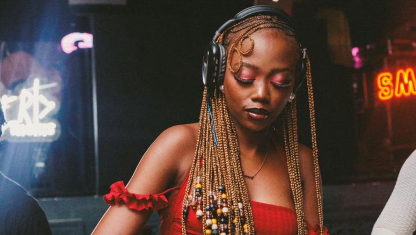
By day, she’s behind a strategy deck. By night, she’s behind the decks. Bunmi has built a name for herself as a true multi-hyphenate: a corporate professional who refuses to be boxed into one identity, and a DJ whose open-format sets blend Afrobeats, Afro-House, 3-Step, and Amapiano into genre-defying mixes that keep dance floors guessing. Her journey, from a rule-following “good kid” who questioned why life had to be lived in one lane, to a woman fluent in both boardrooms and basslines, is a masterclass in refusing to choose.
In this conversation, Bunmi the DJ opens up about her childhood, the discipline that lets her thrive in two worlds at once, her creative process behind the decks, and the quieter moments of rest and reflection that keep her grounded through it all.
Let’s start at the very beginning: before the boardrooms and the DJ booths, who was Bunmi growing up, and how did your early environment shape the multi-hyphenate you are today?
Bunmi grew up as a happy-go-lucky, sorta goody-too-shoes kid, if I might add 😅.
As a kid, I absolutely loved listening to the radio; I’d stay up listening to Billboard Hot 100 or some Top 40 countdown… I just remembered, the Ryan Seacrest American Top 40 that somehow got broadcast on our radio, I knew all the cool stations that played the best music! Even on the TV too, you’d find me glued to Trace Top 40 or Soundcity Videomix shows all the time!
Growing up, I always loved to ‘follow the rules’ because I was a strong believer in the ‘good kids get Santa’s treats at Christmas’ type of ideology; like, if you’re a good person, life would automatically treat you nicely at all times. People used to think I carved out my morals because I grew up as a pastor’s kid. Still, nah, I genuinely liked being the “good child” and “teachers’ favourite” kinda kid, haha 😂. I was a Prefect for two years in high school and ardently a fellowship student in uni, even becoming an exco in church. Still, there were some things I had always questioned along the way, like why I couldn’t take literature or catering classes as a science student because it was for kids in “art class”; or when my fellowship members were so mad at me for partaking in a singing competition in my hostel when I was in year 3 because I “sang secular music to win”… Why were people so obsessed with boxes and everything being one-dimensional? Why can’t there be a mix?
From that point, I began to question a lot of things, because I realised life isn’t so black and white; I think it was the first time I somewhat experienced an identity crisis and began to question everything I had built my persona on up to that point. I would say I came out of that phase knowing that I was not built to be one-dimensional, especially as a child of God. Philippians 4:13 literally says, “I can do all things through Christ who strengthens me,” so why should I let anyone else tell me otherwise!
You’ve spoken about refusing to fit into a single box. Was there a specific moment in your corporate career where you realised, “I absolutely need to spin records,” or did the DJ persona develop naturally alongside the boardroom?
I wouldn’t say there was a big bang moment where it felt like a flash of light revealed to me to become a DJ, but I’d also admit there were strong pointers, like when I’d make playlist for friends and they’d enthusiastically give me feedback without me even asking, to say they love how I’m able to put together genres of good music that most people don’t even know. There have also been several times where I imagine two or more tracks blending together in my head, and one day I just said, why don’t I share this with more people? I could be a DJ and introduce a larger crowd to cool music and amazing mixes, and that was it. I decided to find a professional to actually teach me step by step, so after speaking to a few friends about it, one of them linked me up with my teacher; next thing, I paid for classes, and the rest is history.
Balancing strategy decks by day and DJ decks by night requires serious mental switching. How do your corporate skills make you a better DJ, and vice versa?
One thing I’ve realised that sets me apart is the ability to be on track with schedules and timing. I take agreements very seriously and try my best to honour my commitments regardless of the circumstances. If, for any reason, schedules have to change, I would always communicate it professionally rather than leave people hanging or be a no-show, and these are things I see as basic etiquette, but I think my life in corporate may have shaped that, because I realise not everyone thinks like that.
Vice versa, being a DJ has sharpened my multitasking skills at work, and it’s pushed me to work even harder, because I never want a situation where it’s like, ohh, she does things outside of work now, so she’s beginning to slack… Never.
You started out as an avid music lover making playlists for friends. What was the exact track or transition that made you think, “Okay, I’m ready to take this from the playlist to a live crowd”?
As I said, there wasn’t one exact track or moment; it was just the realisation that there’s a plethora of good music and unknown genres out there that I MUST introduce to people. That’s what I’d describe as the core of my work as a DJ: introducing people to good music and vibes they never thought existed.
As a female multi-hyphenate navigating both corporate structures and the nightlife industry, what traditional expectation has been the most satisfying to disrupt?
That, as a female in a male-dominated industry, you have to have a certain “appeal” to be accepted or visible. On this one, I’m glad that not just me, but many female DJs, have shattered this table, because we have a lot of female DJs expressing and carrying themselves in the most unique and authentic ways, and we’re doing amazing!
Your brand strongly resonates with ambitious young Africans trying to navigate work, identity, and personal growth. What is the biggest piece of advice you have for someone who feels pressured to choose between their day job and their creative passion?
Not just young Africans, I’d say young people, or just even people in general: my advice is it’s NEVER TOO LATE to pick up a new thing, either on the side or full-time. I think this is what makes people so fearful to start; they feel like if they lose the comfort of what they know, they might fall into a world of uncertainty, but guess what? Comfort and complacency are enemies of growth. You don’t have to go rogue, just start that thing in bite-sized efforts and see where it takes ya. Be consistent at it, and you’d be amazeddd!
You describe yourself as an open-format DJ, but you lean heavily into Afrobeats, Afro-House, 3-STEP, and Amapiano. What is it about the energy of 3-STEP and Afro-House right now that excites you most when you’re behind the decks?
It’s how it feels familiar yet new at the same time. With 3-Step, when the intro plays, it feels like you know it till the lyrics come on, and you realise it’s a whole different song! And there’s a way Afro-House creates that euphoric sensation that’s not easy to explain… So beautiful.
You’re known for blending local and global sounds into hybrid mixes that some might deem “impossible” to transition. Can you share a specific, unexpected sonic mashup you did that completely caught the crowd off guard and worked beautifully?
Hands down, it has to be when I recently did a mix of Michael Jackson’s ‘Dirty Diana’ and Asake’s ‘Olorun Ni’ and ‘Dull’ at the Spotify x WTS Inserts night celebrating Asake’s M$NEY album. It caught the entire crowd completely off guard and glued them to the decks; that was what I was going for! 😅
From playing intimate brand gigs like Cafe Riddim to high-energy nights like Inserts Nights and Tamba, how do you read a crowd and adapt your set when transitioning between corporate brand energy and late-night rave culture?
Usually, DJs come with a pre-arranged playlist depending on the expected vibe, but as a good DJ, you’d know most times you don’t end up sticking to it 100%, because you’re dealing with people and moods, and you have no idea what could’ve influenced their energy throughout that day before they found themselves at your set. It’s important to notice when the crowd’s energy is high, solemn, or dropping, and know when to keep it steady or ramp it up. Basically, I don’t keep my head down; I’m constantly interacting with my crowd and reading the room for energy signals.
When you are looking for new tracks to add to your crates, what is the first element that needs to grab you? Is it the baseline, the emotional depth, or the pure rhythmic energy?
It depends on what energy I’m looking to create. Usually, I like to throw people off at first with something absolutely unexpected before introducing them to a familiar vibe. So that beat drop and rhythmic element is very important to me, because I want the crowd to stop in their tracks wherever they are in the venue and think, “Hmm, what is this? I must move closer to find out,” as soon as I get on the decks.
If your corporate workspace and your favourite DJ booth swapped dress codes for a day, what are you wearing to the boardroom presentation, and what are you wearing behind the decks?
Boardroom: tank top, jhorts, a good belt, and my sneakers. Decks: a tailored long-sleeve crepe gown or full-on pant suit.
Picture this: You’re playing a peak-time set at a packed venue, and the power completely trips. The crowd goes silent. Without using music, how do you keep the energy in the room alive while the tech crew scrambles?
I’d pick up the mic and interact with the crowd. I’d ask if they’re having a good time, make it feel like a safe space, heck, even ask someone to come up and show us a hidden talent 😅
If your mixing style were a specific drink or food, what would it be and why?
I’d say a half-and-half pizza: on one side, southern BBQ style with all the types of meats you can think of, and on the other side, mushrooms and olives with bell peppers, and then extra cheese to top the entire thing. The best of both worlds, because that’s what my mixing feels like.
You get the chance to curate a 3-track playlist that every executive is forced to listen to before their morning strategy meetings. What three tracks are on it to set the right vibe?
Asake, “Gratitude”; Kanye West, “Good Morning”; Onyeka Onwenu, “Iyogogo.”
If you could go back in time and open a set for any legendary African icon, dead or alive, who are we opening for, and what is the very first song you play?
Asa: “Jailer,” in an Afro-House mix.
Outside of the corporate ladder and the music charts, how do you define personal success and fulfilment for yourself at this stage in your life?
Personal success, for me, looks like developing a deeper intimacy with God, being an inspiration to many who are scared to take that leap of faith to do something beyond what they consider their norm, and being at peace with dropping certain expectations, knowing that my journey is unique and my steps are ordered, so I need not panic. Additionally, being able to give back incredibly to my parents, my family, and my day ones, really.
Since you document the realities of balancing a heavy workload with everyday life, what does an absolute “zero-productivity” self-care day look like for Bunmi when the laptop is shut, and the decks are unplugged?
A staycation out of the house, all by myself: sheet masks, warm towels, my old favourite tracks on blast; K-pop, EDM, House, Indie, Afrobeats, 3-Step, Alte, Pop, Gospel, Classics, everythinggg, etc. People think I’m an extrovert because I socialise very easily, but I’m actually an ambivert. I need a good amount of alone time to recharge sometimes.
When you’re feeling overwhelmed or facing creative burnout, what is a non-musical hobby, habit, or safe space that helps you recenter yourself?
Um, first of all? Ice cream. Also, there’s a place called the prayer room that I like to go to when I feel absolutely burnt out and unable to move. Also, I’d try to rest, because I barely ever give myself breaks between all of the hustle and bustle of my life.
Is there a specific book, quote, or piece of advice from a family member that acts as your personal anchor when navigating the chaotic energy of both corporate spaces and nightlife?
When Nike said, “Just do it,” they really didn’t lie. They ate with that. It’s literally how I started DJing. When people ask me how I balance DJing with corporate life and content, my response is, I just get up and go. That’s it. I don’t give myself the chance to think about it too much, to the point of doubt, because I’m actually an overthinker most times 😅
If you could sit down with the teenage version of yourself, what is the one thing you’d tell her about the woman she is going to become?
I’d say, Bunmi, the woman you’d become is gonna absolutely shock you! In ways you never imagined, but also in a good way.
Leave a Reply