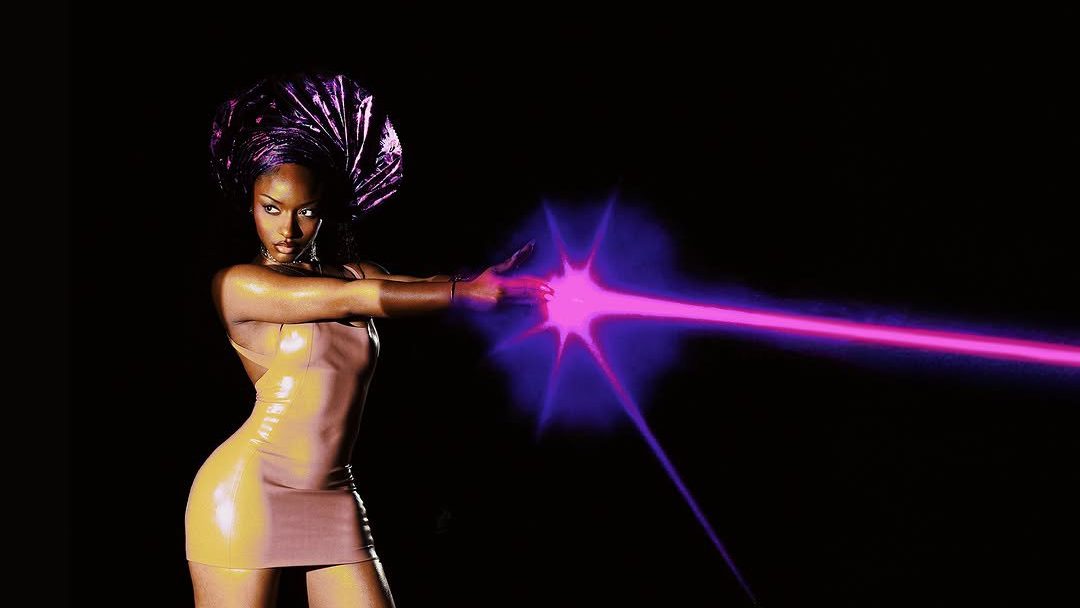
Starrgirl does not arrive asking for anything. That would be the wrong way to start. Because it does not need the cushion of managed expectations. It arrives, all 46 minutes and 16 tracks of it, fully aware of what it is and what it is doing, and it asks you to keep up.
This is Ayra Starr’s third studio album and her fourth project overall. The first two established her. The self-titled EP introduced the voice. 19 and Dangerous announced the artist. The Year I Turned 21 showed the range and the ambition. Starrgirl is something else entirely. It is the project where the range, the ambition, and the identity all arrive in the same room at the same time, arranged well enough that nothing feels like it is competing with anything else.
The title is a deliberate departure. She spent her first two albums naming herself after her age, marking time, documenting stages of becoming. Starrgirl has no age on it. It is not about where she is in the journey. It is about who she is, stated clearly, without qualification.
“Dangerous” opens the album with Terry Apala’s praise vocals introducing her as the Starrgirl before she takes over. “Mobbstars na my family. Bring the contract.” It is braggadocious in the specific way that only works when the artist has already earned the right to say it. The production is layered, confident, and it sets a standard the rest of the album works to maintain.
“Amazing” with kwn follows immediately into intimate territory. The eroticism is unambiguous and both artists lean into it fully without the record becoming crude. This is sensuality handled with songwriting intelligence, which is harder than it sounds. “Pressure” with Leon Thomas continues in that register but with a warmer Afrobeats pulse underneath, his polished RnB sensibility sitting alongside hers without either swallowing the other.
Then “Gimme Dat” with Wizkid arrives, one of the pre-released singles, and it lands differently inside the album than it did as a standalone. She is negotiating something, “I want that peace of mind wey dey come with awoof,” and he responds with the kind of commitment that sounds sincere rather than performed. The song was already widely loved. In context, it earns its place in the tracklist properly.
“Tornado” is the album’s clearest statement of self-assurance. Shizzi and Skillies build a beat with groove and catchiness that match the lyrical ambition. “Inflation, I’m the price they wanna beat.” The wordplay across this song is the kind that makes you replay lines to make sure you heard what you think you heard. “Midnight in New York” follows with house and techno-laced production, and this is where the album makes its most interesting genre move. She is not doing an Afrobeats version of house music. She is making house music, with her voice and her story inside it, and the result is one of the project’s most exciting records. She co-produced this track alongside LONDON and Matt James, which is worth noting. This is an artist who is inside the construction of her music, not just its performance.
“Hot Body” is lighter and more playful, built for motion rather than reflection. “Ms Paper” with Theodora rides a Bouyon rhythm that is genuinely unfamiliar territory for Nigerian pop and works because both artists give the record exactly what it needs. Theodora’s French verse adds texture and the repeated hook gives it an instant catchiness that makes it impossible to dismiss as an experiment for its own sake. This is the album most demonstrably proving that she has listened widely and sat with sounds long enough to inhabit them rather than just borrow them.
“Who’s Dat Girl” with Rema is a record five years of roster sharing finally produces. Both are among the most recognisable young voices in Afropop and their chemistry here is real. He arrives “all Balenci” and delivers a verse with enough personality and precision that it does not feel like a guest feature so much as a full artistic conversation. “Where Do We Go”, produced by ILYA, is the album’s most global-facing production and it works precisely because Starr grounds it in her own emotional reality rather than chasing a sound that feels foreign to her.
“Dance” is pure joy and pure house, her rap-sing delivery across it as effortless as anything on the project. Misunderstood is a guitar-led reflection on being underestimated and finding her own way regardless. “She was a black sheep in the middle of a white room.” The third-person lyrics create distance that somehow makes the song feel more personal, not less. Letter to God turns inward, piano and crashing cymbals building into something close to gospel, and Heaven Baby with ZAYN closes the main album on a tender, percussion-free note that lets both voices exist in the same intimate space without competition.
The feature list deserves its own moment because on first look it raises questions. Leon Thomas, kwn, Danny Ocean, ZAYN, Theodora alongside the familiar Nigerian names. Given her recent crossover history, Santa with Rauw Alejandro and Rvssian, BOOMPALA with LE SSERAFIM, the instinct toward international collaboration makes sense. But there is an honest observation to make here. The Nigerian features land with more weight than the international ones across the board. Wizkid on Gimme Dat, Rema on Who’s Dat Girl, these feel like full conversations between equals who share the same cultural ground. The international guests deliver, some more than others, but they deliver differently. ZAYN on “Heaven Baby” is the exception that proves the rule, his falsetto sitting against hers with a tenderness that needs no translation. “Ms Paper” with Theodora works because the Bouyon rhythm gives them both a shared sonic language that transcends the language barrier literally. The others are solid without being essential. It is not a criticism of the choices. It is an observation that Ayra Starr in her natural environment, surrounded by artists who grew up in the same sonic world, is still her most compelling self.
The production and engineering team deserve naming properly. Johnny Drille mixed and mastered 10 of the 16 tracks, continuing a relationship with her music that stretches back to the beginning. His fingerprints are on why this project holds together sonically even as it moves across genres. Dro, who has become a recurring name in top tier Afrobeats productions, contributes alongside Jean-Marie Horvat, Colin Leonard, Fermin Suero Jr and more on the engineering side. The album sounds expensive not because money was spent carelessly but because the right people were in the right rooms.
A Deluxe version is already confirmed, with more party-leaning records incoming including a collaboration with Brazy. The fact that Starrgirl as it stands can absorb that news without feeling incomplete speaks to how well the 16-track version works as a complete thought.
Two things are genuinely rare about this album. The first is that the pre-released singles, Gimme Dat, Tornado, Hot Body, Who’s Dat Girl, Where Do We Go, are all excellent records, and yet the album still has new favourites on it that those singles did not predict. Midnight in New York. Ms Paper. Amazing. Dance. That is an increasingly uncommon achievement in the streaming era where albums are often just collections of singles with filler between them. The second is that across all 16 tracks and all the genre movement, she never sounds like she is performing. She sounds like herself in different rooms, which is exactly what the album title promises.
Starrgirl is not an escalation of Ayra Starr. It is a solidification. Everything that was promising about her earlier work, the voice, the wordplay, the instinct for sonics, has been refined and arranged into something that does not need to announce itself. It simply is.
This piece was written by a contributing writer, Tobi Oke.
Leave a Reply