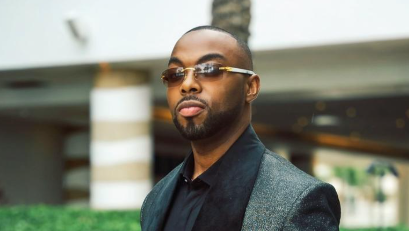
Some of the most recognisable Nigerian records of the last decade carry his fingerprints, even if his name doesn’t come up first. Uyo Meyo. 1 Milli. Seven tracks on About 30. Bakare Michael Seyifunmi has spent years shaping the sound behind the sound, working as composer, producer, arranger and music director across some of the country’s biggest catalogues.
Lately, his work has taken on a different shape entirely. As the music director behind Adekunle Gold’s international tours, Seyifunmi has been the one translating Afrobeats for symphony orchestras, taking songs built for speakers and dance floors and finding a way to make them hold their own inside rooms like the Royal Festival Hall in London and a newly renovated National Theatre in Lagos. It’s work he describes as a negotiation rather than a translation, protecting what makes a song recognisable while giving an orchestra enough room to still feel essential.
That negotiation has taken him further than the stage. He’s been invited to speak at Guildhall School of Music and Oxford’s Mansfield College, institutions that don’t typically turn their attention toward Afrobeats production, and he’s treated those invitations as proof of something bigger: that the genre is no longer just being consumed, it’s being studied.
We caught up with Seyifunmi to talk about chaos on stage, the weight of the National Theatre show, and why he thinks of orchestral Afrobeats as ‘the golf of music.’
You’re credited as a Music Director, Composer, Producer, and Arranger. For someone encountering your work for the first time, what does that actually mean in practice, and which of those roles do you enjoy the most?
I would say in practice, those roles all shape different parts of the same musical vision. As a Composer, I create the music, as a Producer, I shape the sound and recording, as an Arranger, I decide how the instruments and vocals work together, and as a Music Director, I bring it all to life on stage and make it more relatable and bigger because now the audience can feel the energy and vibration from musicians right in front of them. If I had to pick one, I’d say Music Director because it’s where composition, leadership, and live performance all come together, with no rules. I can decide to introduce a 200-year-old instrument into the music to tell a story that affirms the essence of the song.
You’ve been behind some of the most recognisable records in Nigerian music. Uyo Meyo. 1 Milli. Seven tracks on About 30. When you’re working at that volume, how do you keep each project feeling like its own thing?
First of all, you have to know that every record has its own spirit, and you have to allow it to guide you. You have to understand the reason for creating it in the first place; that’s what has been helping me keep each project feeling like its own thing. A song like Uyo Meyo has a completely different message from something on About 30 or FUJI, different energy, different intention, different story. If you try to force the same formula on every record, you kill that individuality. So I let each song tell me what it needs, instead of the other way around.
You’ve held the Music Director role across his international tours through North America, Europe, and Australia. What does that job actually look like from the moment you land in a city to the moment the curtain comes down?
Usually, the moment I’m in the city, I coordinate the sound check. I have to check with the production team if everything we planned is still possible, things like lighting and visuals for the performance. Sometimes I have to adjust performances based on the atmosphere. If it’s a festival, I like to watch another artist’s performance, or a few performances, before mine, so I can read the crowd and properly adjust the setlist or arrangements. When it’s time to perform, I have to direct in real time based on the energy of the crowd, managing at least three things at once: the band, the artist, and sometimes the production team. After the performance, I have to note the things that need to change for the next one.
Orchestrating Afrobeats for a symphony orchestra is not a translation; it’s a negotiation. Where does the original production have to give way, and where does it hold firm?
It’s exactly that, a negotiation. When you’re orchestrating Afrobeats for a symphony orchestra, you have to remember that orchestra isn’t what everybody listens to; it’s like the golf of music. Not everybody watches golf, but it’s premium. Orchestra will always feel new to most of the audience, so you have to strike a balance between what they’re used to and something more sophisticated. You have to sit right in the middle. The original production has to hold firm on originality. The audience has to feel at home, and when I say home, I mean what they’re used to hearing. The arrangement can never stray so far from the original that it starts to sound alien; that’s non-negotiable. Where it gives way is in how much room you let the orchestra take up. You have to create pockets for every moment, a pocket for originality, a pocket for the wow moments, and a pocket for the orchestra, so everything complements each other rather than competing. It can’t stray too far from what the audience knows, but it still has to sound fresh and big. That’s the negotiation, every single time.
When you’re arranging something like Sade or Lailo for a full orchestra, how much of the original production are you protecting, and how much are you willing to let go for the sake of the live experience?
With songs like Sade and Lailo, there are certain things you simply can’t touch. The acoustic guitar on Sade, for instance, is untouchable; it’s the signature sound of the song, the thing that makes it instantly recognisable. So with tracks like those, my job starts with identifying whatever defines the song’s identity, and then building the orchestral parts around that core, so the orchestra amplifies it rather than competing with it. I can let go of the structure, the instrumentation filling the space, and even the tempo, for example, I decided to modulate the second verse of Sade for the orchestra performance. The most important thing for me is protecting the core identity of the song.
What’s the most chaotic thing that’s ever happened on stage that the audience had absolutely no idea about?
The most chaotic thing that happened on stage was when my playback system stopped working mid-show. I had to quickly inform the band and the artist about what was happening, and we played fully live for the rest of the performance. This was a long time ago, before I knew about redundancy and other preventive measures. I can tell you, it was an extremely scary moment. After that, I went to Los Angeles to take a masterclass on playback engineering. I was trained by one of the best to ever do it, Laura Escaude, just to prevent things like that, and other quirks of live performance, from happening again.
Royal Festival Hall in London and the National Theatre Lagos are two completely different rooms with two completely different audiences. How did you approach the same songs differently across those two nights?
Although the Royal Festival Hall in London and the National Theatre in Lagos are two different rooms, the audiences aren’t so far apart, to a large extent. So instead of changing the approach to the songs, I changed the arrangement of the setlist to suit the demography. It wasn’t about changing the approach to the songs; it was about changing the approach to the setlist, which song comes first. There was also access to some of the featured artists in Lagos, so I had to rearrange songs like Many People to accommodate Yinka Ayefele and Adewale Ayuba, and High to accommodate Davido. That was the major change in approach.
The National Theatre Lagos show was the first concert at the venue after its renovation, with the MUSON Orchestra. What was the specific weight of that moment?
The National Theatre will always be part of my story. I’ll talk about it till the end of my career, because being part of the first concert there since its renovation, and doing it with the MUSON Orchestra, was a huge moment that shaped live music culture in Nigeria. That venue means a lot to me personally. The first time I was there was on a school trip from my primary school, so to come back and perform on that same premises, as part of something that historic, means a whole lot to me.
How do you feel about the fact that a lot of Nigerian artists are now embracing orchestra-style live performances?
I feel good about it. It means the yearning and taste for quality live performances is growing, people now know what a real live performance should sound like, and what mediocrity sounds like, too. It’s pushing more artists to take their job as entertainers seriously. Orchestra concerts are like the golf of music, it’s premium, so go for it if you can. I’m happy to be part of those at the forefront of reshaping the culture in this new age.
After London, the Guildhall School of Music invited you to hold a session with their students. Then came Oxford’s Mansfield College, for a talk on the Art of Adaptation across Literature, Music and Film. Those are institutions that don’t typically turn their attention toward Afrobeats production. What do you think those invitations are actually saying?
For me, that’s proof that Afrobeats is no longer just being consumed, it’s being studied. When institutions like that invite you to sit with their students and speak on your process, it means the world is starting to look at what we do as a serious musical tradition, not just a sound that’s trending.
When you sit in front of Guildhall students, what’s the thing you most want to disrupt in how they’re thinking about music from the continent?
One of the things I disrupted is the idea that African music is just texture, or colour, something to sample or borrow rhythm from. I want them to hear it as music that carries culture, history, language, and specific meaning. Every rhythm, every chord choice, every phrase is saying something; it’s not decoration, it’s not just vibe. I even talked about the talking drum as a whole family of its own, from the Iya Ilu, the mother of drums, down to the omele, the children. When you understand that, you stop treating the music as raw material and start treating it as a tradition with its own depth, the same way you’d approach any classical work.
The production now moves to North America for the first time. Toronto, then Newark. What changes in how you prepare, and what has to stay exactly the same?
Taking the orchestra concert to North America, Toronto and New Jersey stretched me a bit. I had to work with two different orchestra teams and two different conductors, so I sent them the sheet music, did a lot of auditions, and literally worked with more than 75 people. Rehearsals and show schedules were back-to-back, and I was flying from one country to another in between, so the preparation was quite taxing, but it was extremely successful in the end. What stayed the same was the core arrangements, but I did have to restructure some songs based on what I learned from previous shows, and because of the crowd out there, and I also added a few more songs from the deluxe album.
What do you do when you’re not consumed by your music work?
When I’m not consumed by music, I try to catch up with what’s happening in the information technology world, especially AI and cybersecurity. I also focus on my other businesses.
What song is your current obsession?
A song titled “Maisha Ya Milele” by a choir in Tanzania, Kwaya Ya Uinjilisti Ya Vijana Arusha.
Seyifunmi Michael has arranged Afrobeats for symphony orchestras from the National Theatre Lagos to the Royal Festival Hall in London, and lectured on it at Guildhall and Oxford along the way. He talks us through the negotiation between originality and orchestra, the night his playback system failed mid-show, and why he calls orchestral concerts the golf of music.
Leave a Reply