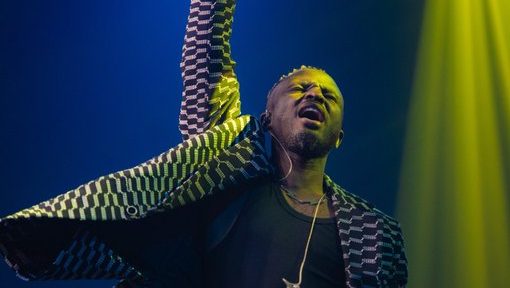
I’ll open with a bit of honesty: I don’t listen to church music. As I’m not Christian, I simply have no reason to. However, there are artists on my frequently-listened playlists who make gospel music, but who also, either by design or providence, create their art in such a way that it’s accessible and enjoyable to everyone. On this list, you’ll find Kirk Franklin, that one Kanye album, and of course, Gaise Baba.
That accessibility is what Gaise Baba has built a career on. For fifteen years, Gaise Baba has built on the foundation of one stubborn argument: that gospel is not a sound, a hairstyle, or a seating section at an awards show. It is a message, and a message can travel in whatever vehicle gets it furthest. That argument has carried him from a 2010 debut in Nigeria’s gospel circuit to a Billboard-charting anthem, a UK arena tour, a talk show he hosts himself, and, as of a few weeks ago, a public standoff with the country’s biggest music awards over where his songs are allowed to compete.
Born Akinade Ibuoye, the artist studied Economics before adding a Music Business programme at Berklee, a combination that shows up less in his lyrics than in how he runs his career: less choir, more company. He treats faith music as an industry to be built rather than a lane to stay in, using festivals, a podcast, and youth programming to widen the audience for what he calls Afrogospel, a sound that borrows Afrobeats’ rhythmic architecture and Yoruba, English, and Pidgin phrasing but keeps its lyrical centre on scripture and testimony.
That philosophy found its loudest proof of concept in May 2025, when “No Turning Back II,” his reworking of the old evangelical hymn “I Have Decided to Follow Jesus” with fellow artist Lawrence Oyor, went from gospel single to chart-shattering “you had to be there” moment. It debuted at No. 16 on the Billboard US Afrobeats Songs chart and topped YouTube Nigeria’s most-viewed list for the year, all while spreading into spaces gospel songs rarely reach: TikTok trends, secular playlists, and surprisingly, nightclubs.
The virality came with backlash. Nigerian pastors publicly criticised the record, with one preacher comparing its intent unfavourably to the original hymn and questioning whether the song carried the same spiritual weight. Much of the criticism, though, wasn’t theological at all; it targeted Gaise Baba’s appearance, his dyed hair and chains, a style closer to contemporary Afrobeats than to a church pulpit. He pushed back directly, telling Channels Television that he was less concerned with being judged on appearance than on character.
Asked directly whether that wave of criticism changed anything for him, his answer was blunt: it didn’t, because it wasn’t new. “My professional career started in 2010, and I have faced criticism almost all through it,” he said, describing years of being told his sound was “too cool, too wavy, too edgy for church.” What was different in 2025 was scale, not substance. “No Turning Back II” simply went global, and the same old argument found a much bigger room to happen in. His response hasn’t changed either: “My duty is to execute the assignment I have, not to explain it to those who do not understand it.”
“Gospel is not a genre, it’s a message.” That line, delivered at a US Consulate event in Lagos, is close to his clearest thesis statement. His argument is that a song about drugs gets filed under whatever genre its beat belongs to, but a song about faith gets quarantined into a “gospel” category regardless of what it sounds like, treated as a subject rather than a style. It’s a framing he’s repeated often enough that it now functions as his brand philosophy as much as his theology.
It also explains why he keeps showing up in rooms gospel artists don’t usually play. He performed at the Afrimma Awards earlier this year and at Lagos Fashion Week last year, and points to both as evidence of a broader project he calls “We Outside,” the name of a song and, in his telling, a movement. “This music simply has to go to spaces outside the church,” he said, framing it as expansion rather than compromise, “not about being hungry or desperate for clubs.” Pressed on whether reaching for those spaces has ever cost him a booking, a partnership, or an audience on either side, his answer was, “If this drive and ideology has closed a door, then it was not a door worth being opened; if it has closed doors, it has also opened bigger doors, being true to this assignment has proven otherwise.” He couldn’t recall an instance, and what criticism does reach him, he says, is mostly online commentary rather than anything that’s actually closed a door. If anything, he argues the traffic now runs the other way: “Churches are even embracing Afrogospel now because they see it is the sound of this generation.”
That refusal to stay in one lane extends well past music. He founded LightOut, a schools-focused advocacy initiative that uses concerts to reach teenagers on climate action, drug use, and cybercrime, and ARAMANDA, an Afro-Urban arts festival now several editions deep across Lagos and Abuja. Both treat Afrogospel less as a sound and more as infrastructure, a way to get into rooms and age groups that a straightforward worship record wouldn’t reach on its own.
The same instinct shows up in how he’s built his platform beyond the stage. In 2024, he launched Black Flame, a podcast that told him he needed an audience beyond concert crowds, and took it on the road during a six-week UK debut tour that included a headline show at London’s Shaw Theatre and live tapings in Manchester and Birmingham. His publicly listed partnerships, with the German and Netherlands consulates in Lagos, the British Council, and Lagos State’s climate office, position him closer to a cultural diplomat than a conventional gospel act, though those figures and partnerships are drawn from his own press materials and are worth independently confirming before publication, as are his self-reported streaming and chart numbers.
It’s that same argument, that faith content shouldn’t be confined to one section of the culture, that put him on a collision course with The Headies last month. On August 28, days after releasing his new album, Gaise Baba published an open letter after “No Turning Back II” was left out of the awards’ general-field nominations. His central claim, in his own words: “a rap record is a rap record” regardless of subject matter. He pointed to a 2024 precedent, a nomination in the newly created Inspirational Music category that, he says, was never announced on stage despite the ceremony running more than five hours, and drew a comparison to how the Grammys have historically kept African music categories off the main broadcast. Reframing the criticism that followed, that he’s campaigning for recognition under a label he claims limits him, he insisted the letter was about the system rather than himself: if songs that objectify women get unrestricted radio play all week, he argued, a song that “gives life” shouldn’t be boxed into Sundays or a single category. He remains nominated for Best Inspirational Single at the 18th Headies, set for Toronto on October 25, alongside Sunmisola Agbebi, Lawrence Oyor, Sinach, EmmaOMG, and Mercy Chinwo, which makes the letter less a boycott than a pointed argument from inside the tent.
He also drew a correction worth noting for accuracy: he says the complaint was never about his own name being announced. “I did not ask for my name to be called; I asked for the category to be called on stage.” He contrasted the Headies’ handling with a similar category at the AFRIMMA Awards this year, where the winner, an artist named Milo from Côte d’Ivoire, got his moment on stage, which led to an actual connection and, since then, two or three joint records. As for whether he’d still have written the open letter if The Headies had simply called the category’s name in 2024, he didn’t offer a clear yes or no: “I am just saying things should be done right. As to how I would react if called, I guess we will have to wait and see.”
The timing of the letter isn’t incidental. His new album, “God Is Cooking,” released in August, is arguably the clearest musical version of the same case. Its opening track interpolates the late rap pioneer Dagrin and samples juju legend JJ Ransome-Kuti, tying the Kuti musical lineage explicitly into an Afrogospel record. Elsewhere, a collaboration with Afro-house producer Kaestrings pushes the thirteen-track project past anything a “gospel” tag would predict. The album’s own framing: faith, Nigerian musical heritage, and contemporary African sound in one thirteen-track project; reads like a mission statement disguised as a tracklist.
What connects LightOut and ARAMANDA, the “We Outside” project, and the Headies letter is the same insistence: that faith content shouldn’t be graded on a curve, hidden in a side category, or judged by a dress code. Put to him directly, the contradiction his critics raise, wanting out of the gospel box while campaigning for a better seat inside it, doesn’t fully dissolve. His answer treats the Headies nomination and the argument against genre-boxing as two different fights rather than one: the letter, in his framing, is about how the system should function for everyone in that category, not a personal grievance about recognition. Whether that distinction holds up is something readers, and probably a few of his critics, will keep arguing about long after the 18th Headies wraps in October.
Leave a Reply