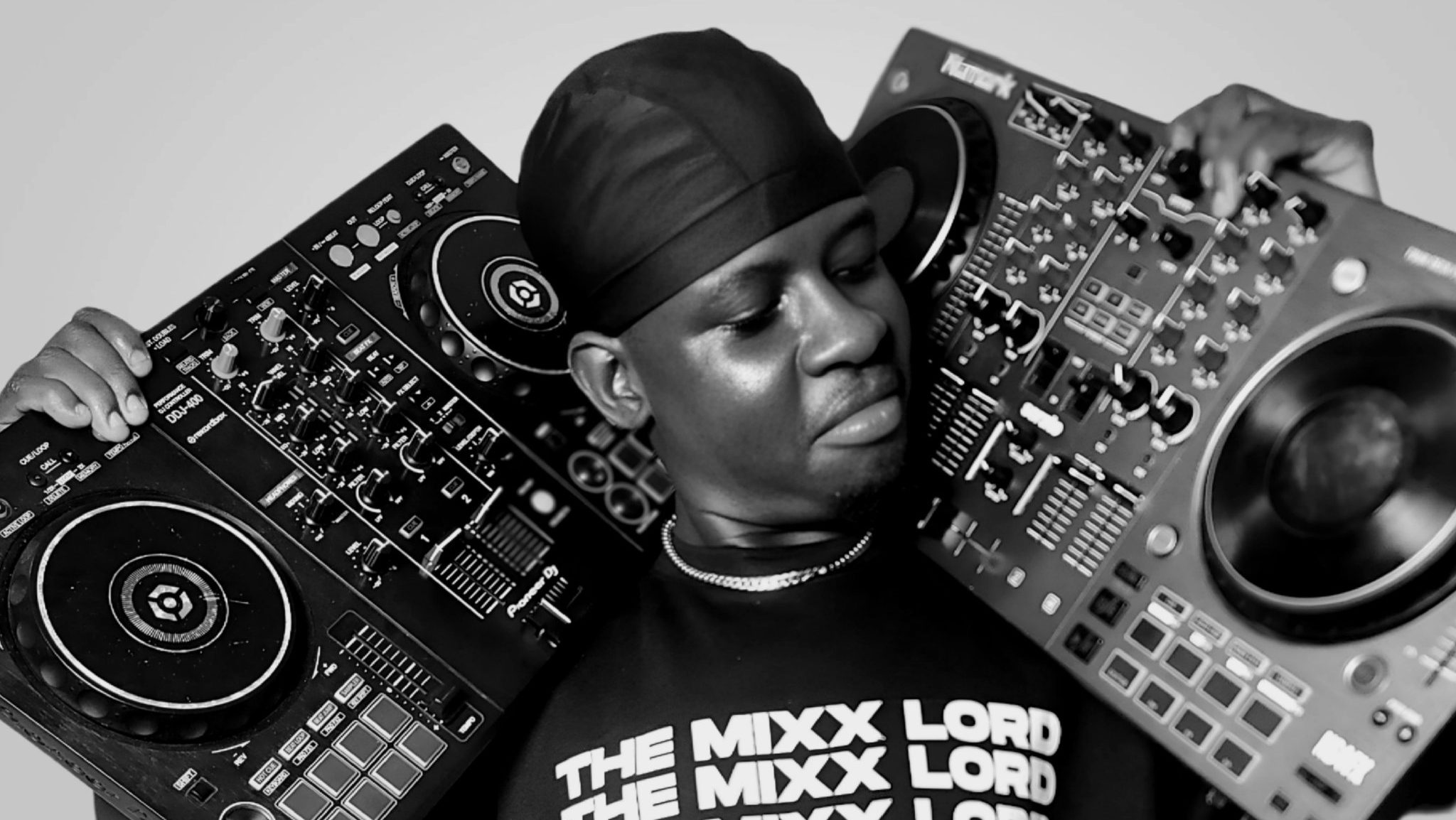
DJ Khalipha is not what you would expect, in that he doesn’t seem like his music. The music is fast and feverish, built on a tempo that doesn’t give you time to think. The person behind it speaks slowly, carefully, with the measured politeness of someone who was raised to be decent and has not stopped trying. He laughs easily but not loudly. He presents as humble, eager to share his thoughts, and has a personality best described as cute. His favourite music to listen to, alone in his room, is ambient. Instrumental. The kind of music that has no interest in being noticed. He is, in almost every observable way, not his music. And somehow that is exactly the point.
Habeeb Kola Lawal, DJ Khalipha, was born in Orile Iganmu. He grew up in Ajah. He went to school in Ilorin. Three different places with three different paces, but when you ask him which one made him, he considers it genuinely before landing somewhere unexpected. “What actually made me who I am is being indoors,” he says, “not the environment. I used to be an introvert. I like to stay inside. The inspiration for most of what I became came from being lonely inside, staying alone.”
His Household was not a musical one, not in the way that produces people who talk about music in terms of inheritance and tradition. What they had was a television, and what he did with it was unusual. Instead of just watching, he catalogued. “I try to familiarise myself with different kinds of sound,” he says. “Songs, cartoons, movies, and games, I’d cram them, keep them in my head.” But even that wasn’t enough. The sounds as they came were never quite right. Too slow. “I don’t like sound in the way it’s normally presented,” he says. “I like modifying it in my own brain.” He pauses. “I think that thing is what made me a producer.”
At university, that instinct finally found a tool to work with. He went to YouTube looking for apps that could do what his brain was already doing: modify songs, change their tempo, pull them apart and reassemble them. He found Virtual DJ and started practising on his phone, in his room, for nobody. It was just what he did when he had time, the same way some people doodle. “I’m this kind of person,” he says. “When I’m less busy, I’m always trying to see, can this sound work with this?”
Khalipha’s origin story is one for the books, and it’s all thanks to one friend who looked over his shoulder one day and told him he had something. Khalipha was unconvinced: he was using a phone, and that felt like a serious limitation. But the friend was persistent. A student union gig followed, and when he showed up with his phone and a small MP player, he was told to prove himself before they’d take him seriously, and he did just that. The crowd was surprised that a phone could run an event. When he upgraded from a phone to a tablet, they called him Tablet DJ. “At first they were mocking me,” he says, with the quiet satisfaction of someone who has been underestimated enough times that being right about themselves still feels good. “But I was able to convince them, it’s not about what you use. It’s about what you can deliver.”
On the side, he was also teaching in a school during this period, saving the salary, working his way from phone to tablet to proper laptop. This was necessary because he wasn’t making any meaningful money from DJing: his first gig paid roughly fifteen to twenty thousand naira, and by the time he covered transport and logistics, what was left was maybe two or three thousand. “I used it to eat,” he says, and then laughs.
The name Khalipha came when the music started to feel real. His father was a strict man. Even allowing his son to be a DJ had been a difficult conversation, softened only by the fact that his brother had gone first and survived it. Habeeb understood the assignment. “I knew I could not use an ‘anyhow’ name,” he says. “I had to use something decent and meaningful so he’d be happy and not discourage me.” He went to Google. He searched for the Arabic word for successor, for the firstborn, the one who carries something forward. The word that came back was ‘khalifa’. DJ Khalipha. It is such a considered, almost tender piece of problem-solving: a young man finding a way to honour his father and his music in the same breath. Sadly, his father died three years ago. But he lived long enough to watch his son go viral.
The sound that made DJ Khalipha a household name did not come from where people assume it did. This is perhaps the most important thing to understand about it, and also the thing he is most patient about correcting.
“When I was creating Mara,” he says, “it was not influenced by anything ‘street’ at all.” He says it the way you say something you’ve said before and expect to have to say again. “It was more influenced by ambient sounds and South African music.” He loved the way their kicks and percussions land, that particular bottom-heavy, slightly melancholy feeling. But the tempo was wrong for what he was reaching for. “It was too slow for me,” he says. “I like it faster, to give that groovy feeling.” So he pushed. He found the frequency where emotional sound and hyper-fast beat don’t cancel each other out but are instead complementary, so you feel the weight of something and still can’t stop moving.
He is meticulous about defining this. “Mara is not street music,” he says, quietly but firmly, determined to correct this misunderstanding about his baby. “It’s a sound that blends the street and the city together. It has a fast tempo, but if you listen properly, it is an emotional sound blended with a hyper-fast beat. That’s what makes it unique.” He goes further, because he always goes further on this: “You cannot listen to Mara and start thinking about breaking bottles or fighting. It will settle you down. You may feel like dancing, but while dancing, you are also entering another spirit, another world. You are already feeling yourself in another room.”
When it comes to Mara’s place in the long lineage of the different phases of Lagos street music: Galala, Terry G, Zanku, he is careful again. He was not conscious of that tradition when he was making the early beats. The connection became visible later, imposed from outside rather than built from within. “Street was never in the conversation when I started,” he says. “Because I’m not a street guy at all.” What happened instead was that TikTok’s dancers found it first, and they happened to be street dancers, and the association locked in before anyone had written the genre’s definition. “The popularity of Mara came from the street and from dancing,” he says. “But it was not designed because of those dancers. It was created out of curiosity.”
Part of defining what Mara is has meant defining what it isn’t. Cruise Beat and Mara get collapsed into the same conversation often, treated as interchangeable names for the same sound, and Khalipha pushes back on this emphatically. “They are two different things,” he says. The distinction, as he explains it, is both technical and emotional. “Cruise beat sits at roughly 115 to 120 BPM and carries a particular kind of vocal energy on top, using those funny effects and voice notes.” It is built for a specific kind of crowd reaction. Mara runs faster, anywhere from 135 to 160 BPM and sometimes beyond, and where cruise beat wants to make you laugh or hype you up, Mara wants to take you somewhere. “The faster it is, the more energetic it gets,” he says. “But the energy is not the same. Cruise beat is more ‘cruise’, as the name implies. Mara is more about feeling. It’s spiritual” The difference, ultimately, is what the sound is asking of you. Cruise beat wants your attention. Mara wants your whole body, and something underneath it.
The name itself carries history he did not create but has absorbed. Mara carries a meaning that is, according to him, something like ‘rugged’, something like ‘wildly creative’, something that doesn’t translate cleanly but is understood clearly. He found it on Google while looking for something that captured the feeling without calling it a beat. “I wanted it to be music,” he says simply. “Not just a beat.”
The first beats that went viral were made not in production software but in a DJ app. He was just trying combinations, pulling things apart, seeing what happened. He put the result on TikTok without expectation. “I thought it was just play,” he admits, and it is remarkable, the pioneer of a genre who genuinely did not think he was doing anything worth watching. “I was just experimenting, seeing what could work with what.” When he saw it going viral, his first move was practical: go and distribute it properly, protect it. “People found money in it,” he says, still sounding faintly surprised.
When he listens back to those early beats now, he hears something specific. Not the technical gaps, though those are there. He hears a version of himself that surprises him. “The kind of person people expect when they hear my music,” he says, “is a very street guy, a guy with all the swag, very hype. And then they see me: a very calm, reserved, educated guy.” He laughs a little. “I’m just the opposite of what I’m supposed to be.” The emotion in the early music is real, he says, because it came from a real place. There was a music video — a collaboration called Obirin with another artist — where he was present at the shoot, three scenes were filmed, and when the final video came out, his face was nowhere in it. “I was sad,” he says, without drama. “I’d told all my people about the video, they anticipated seeing me, and they were disappointed. I was sad.” That sadness, turned inward and then outward through the music, is where the first viral beats came from.
The question of elitism around Mara, of people who dismiss it precisely because of where it is perceived to have come from, lands on him differently than you might expect. He doesn’t get defensive. He gets precise. “I saw a tweet where someone called it noise,” he says. “I was weak. I was sad. But I understand, because when Mara went viral, every other producer and DJ was jumping on it. They wanted their own viral song. In that process, everybody was just creating without direction, without knowing what Mara is or where it’s going.” What he did was preview one minute of a track under that tweet and ask the person to listen and then tell him it was noise. “The person was able to understand,” he says. “There’s noisy street music, and there’s Mara.” He pauses. “I was able to explain what Mara is with just a single post.” “Mara is not more street,” he says once again. “It has a fast tempo, yes. But that doesn’t make it street. When you listen to Mara on the right BPM, in the right way, it’s something that even a classy person can love.” He has proof. “I’ve seen people who are very classy tell me they listen and love it. International people too. If international people can love Mara, then why not those in Nigeria?”
In a music industry still organised primarily around singers and vocal artists, holding creative authority as a DJ and producer is a particular kind of work. Khalipha is thoughtful about this. “In the Nigerian entertainment system, the way DJs are being regarded is not the way it’s supposed to be,” he says. “But now people are being creative, and they are changing things. Just like me, instead of being a DJ alone, I’m producing my own music too. That’s putting us at the forefront.” He believes the shift is real and accelerating. “The time will come where, the way we have the Big Three singers, we will have the Big Three of the DJs. And people will compare DJs and singers in the same conversation.” He says it with the quiet certainty of someone who has been right before about things people didn’t believe yet.
Mara Pass Mara Beat has over 17 million streams. Rema’s HEIS carries an unmistakable Mara influence. Seyi Vibez has touched the sound. When the mainstream began absorbing what he built, the feeling was not simple. “Gatekeeping isn’t for me,” he says. “Artists can jump on Mara, DJs and producers can jump on it, it’s a general thing for everybody. But it’s not just any song that you create anyhow that you’ll name ‘Mara’. If it becomes that, that’s how people start calling it noise.” He’s happy when people do it right, though. “DJ Cora and Azzi on the Beat create proper Mara. DJ YK too, but more often, he makes Cruise.”
The anxiety underneath the success is real: “Nigeria has this habit of using something and then dumping it when it’s no longer trending. Mara is something I’ve been struggling to keep relevant. From 2022 till now, it has not been easy.” But he has managed it. “Every year, I try to put out something that keeps the sound intact,” he says. 2022 was Obirin. 2023 was Mara Dance. 2024 was Mara Pass Mara. 2025 brought new dances and new records. 2026 has something coming with CKay. “Every year,” he says again, like a promise.
The rebranding from Mara to ‘Street House’ was partly forced and partly clarifying. Streaming platforms had started flagging the word, spammed into meaninglessness by the rush of producers trying to catch the wave. “Even some of my songs were taken down,” he says. So he found a new nomenclature. Street House: Street, so the people who first carried it could still find themselves in it, House because the House music scene in Lagos was where he first felt professionally accepted, where he first played gigs that felt real. “Street House is like a blend,” he says. “Both groups of people can come together.” He was also thinking about the international market, about the need for a name that could travel without losing the thing it was describing. Whether this translation loses something specific, whether ‘street House’ does the same work as Mara in the body of the listener, is a question he holds rather than answers.
Mara’s acceptance doesn’t end with raves. At Nyege Nyege 2025, in front of a global audience, Skrillex wove Mara into his set. Khalipha had played a twenty-minute set at a pre-party the night before, and Skrillex had been in the room. “He came to me and said he loved the sound,” Khalipha says. “He didn’t even ask for the file name, I think he Shazamed it.” The next day, Khalipha arrived at the main stage after his own set on a side stage, and walked in just as his own beat started playing. “Everyone who was there with me was happy,” he says. “We were like, wow.” After the show, backstage, Skrillex said he wanted to work together. “We are cooking something,” Khalipha says, with palpable delight.
James Blake put Mara Pass Mara Beat on his wake-up playlist. The Mara Mania exhibition at Alliance Française, backed by the French Embassy, gave the genre institutional recognition. The forthcoming WTS documentary of the same name is building a record of the scene and its creatives. He welcomes all of it, including the French Embassy, he does not think institutional attention makes the music too posh. “It’s one of the things that has been the backbone for me,” he says. “It gives me the platform to showcase this to the outer world.” He draws the comparison himself: “When Burna Boy started, we didn’t give him attention until foreigners did. Then we knew the Burna Boy we know now. We didn’t give Wizkid the respect he deserved until he had a collaboration with Drake. A time is coming when Mara will be played on a stage in front of a million foreign people who will know it and love it. And then when we come back to Africa, everyone will have accepted it.”
The Nigerian media, he says plainly, has not done enough. “Foreign media, especially in France, are giving it the attention it needs. But the Nigerian media is not supporting it the way it should be. Only very few platforms give us genuine support. The others only want to post what is already trending, not what has the potential to trend.” He is not bitter about this either. He just names it and moves forward, which is, it turns out, how he handles most things.
When he calls his forthcoming EP 2303 — named for his birthday, March 23rd — a showcase of Street House maturing, he means something specific by maturity, and it’s not slowing down or settling. “I’m trying to evolve,” he says. “If you check the EP, there’s a track called Evolve. I’m trying to make sure you have a reason not to criticise, a reason to want to listen. It’s getting more pleasant to the ear. The more I learn, the more I understand: this element is too harsh, this one you can refine, this one you can extend.” Maturity, for him, is the music knowing more about itself.
The biggest personal influence, when he names one, is his father. “I’m the representation of who my dad was,” he says. “I looked up to my dad for many things. He’s one of the biggest influences I have.” His father is gone, but the standard he set is not. Beyond that, Khalipha describes building himself from fragments: character from people he observes, skill from producers he studies, instinct from sounds he catalogues the same way he always has. “I don’t have a strict focus on ‘this is the person I want to be like’,” he says. “I want to be me. But a combination of knowledge from different people, to build what I’m going to become.”
The vision for Mara is simple and total. “Mara is going to go global,” he says. “I’m pretty much sure of that as long as I’m still alive. It is different, it is unique, it is its own style on another level. It is our own.” The vision for himself is smaller, quieter, more personal. “Everything I’ll be doing, I’ll be doing it because of my child,” he says. “I don’t have a child yet, but I want my child to sit down one day, search my name on Google, and see the things I have done. I want everyone around me to be proud of me. And I want to be proud of myself.” He pauses. “I believe I’m going to get there very soon.”
If he could collaborate with anyone, he says Rema. He has a song already produced for CKay. He wants international rappers on Street House records; rap, he thinks, can live inside this tempo if you find the right entry point. “I want to feature Rema very soon,” he says. “I pray it happens.”
When the stream is over, and the name Mara is eventually written into the history of what happened to Nigerian music in this decade, Khalipha will appear at the beginning of the story. He seems aware of this in the way that people who have been building something alone for a long time are aware, not with arrogance, but with the particular relief of someone whose work is finally being seen.
He just wants to eat, sleep, and make music.
Leave a Reply