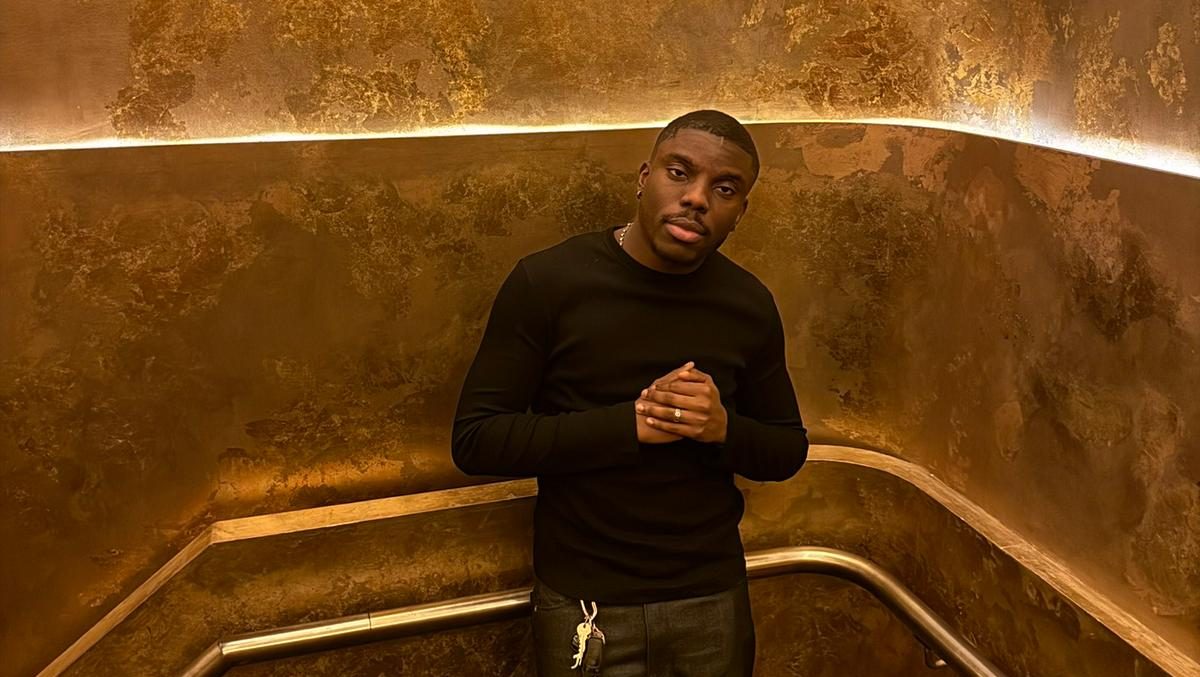
Some people enter the music industry through a door. Ayomide “Taj” Tajomavwo entered through a window: curious, self-taught, and armed with a podcast nobody asked for but plenty of people needed. What started as a music/pop culture obsession in 2015 Toronto became a career that now spans A&R, label management, artist development, and live production. As North America label manager for WeTalkSound, he sits at one of the most interesting intersections in music right now: the pipeline between African artists and a diaspora that is hungry, growing, and increasingly impossible to ignore.
This conversation doesn’t stay in one lane. It moves through the unglamorous mechanics of a music release: metadata, mapping, timing, and into the bigger questions about what global success actually means for African artists, where the industry is failing them, and why a bag of rice and Indomie is, apparently, a legitimate rider request. Underneath it all is a clear-eyed perspective on an industry that rewards leverage, punishes naivety, and is only just beginning to reckon with what it owes the culture it keeps borrowing from.
So, how did you end up in music?
So basically, I would say I started off being an artist manager primarily, because that’s always the easiest entry level into the music space. Prior to being a professional, I was a real culture head, heavy on pop culture and the new scene back in 2015-2016. When I moved to Canada in 2015, I had access to Apple Music and began digging deep into music and the relationships artists had to get in order to get playlisted. I started a podcast called “In the Loop” because I wanted to keep people informed about artists outside the typical mainstream hype. Professional entry usually starts with picking an artist from your circle and growing from there. Now I’m the label manager for North America for WeTalkSound, dealing with clients, partnerships, and negotiating deals. I build campaigns tailored to different artists and genres within the African ecosystem and the diaspora.
Walk us through the pipeline from when the artist delivers the final version of a song to when it goes live. What happens in that space?
I can speak from both the artist and label side. Generally, it starts with deciding which record goes next based on the goal for the year or that specific release. Once we have the mix, master, and artwork, the manager handles administrative work: building drives, press releases, EPKs, and writing artist bios or lyrics. I always advocate for scheduling releases four to six weeks in advance to get the best results, especially without a budget. We also look for distribution partners and investors. On the label side, we receive the assets, upload the music to our backend platform, and pitch to DSPs and guest curators. We also handle payouts and then discuss rollout and marketing campaigns, leveraging relationships to push the music.
There are parts of the job that are not as sexy as others, things like governing the metadata,and managing the ISRCs (International Standard Recording Codes) and UPCs (Universal Product Codes). Have you ever seen a serious metadata mistake that you’ve had to fix?
Absolutely. One of the biggest things is mapping. For brand new artists, music sometimes gets delivered to a brand new Spotify page instead of their existing one, and we have to map that correctly. Another issue is metadata restrictions; artists might want creative titles with slashes or special characters that platforms like Apple Music won’t accept. We have to find a middle ground that works for both Apple and Spotify. Artwork is another issue; Spotify is morelenient, but Apple Music is strict about what logos can appear on the cover. To prevent this, we use a checklist and guidelines to make the release smooth and avoid chasing platforms to change things later.
You’ve managed 30-plus single releases. At what point does volume start to work against an artist? How do you advise clients on the cadence of their releases?
In the Nigerian scene, I advise artists not to drop between September and December if they aren’t big. Everyone tries to crunch their releases then, but DSPs go on holiday in December, and you end up competing for placements and listener attention with superstars who are also dropping for the festival period. I advise new artists to take advantage of the beginning of the year or ensure a project is out by July or August. Use the summer and the end of the year to push the music on the ground rather than just on DSPs.
You’re also an A&R exec. How does your A&R ear work? What are you listening for when you evaluate an artist for the first time?
Confidence. No matter what you are singing, I need you to sound confident. If you can convincingly sing something to me, I’m sold on the delivery, tone, and cadence. In this genre-fluid world, almost anything can fly if the artist believes in it first. Once I hear that swag in the voice, then we can work with producers to tighten it up.
Ikeja (No Go Thief) recently went viral. How much of that was planned strategy, and how much was the record just taking on a life of its own?
I think it’s 50/50. By the time we picked up Danpapa’s record, it was already doing numbers on TikTok because he was passionate about posting videos using the song every day. Our strategy was to convert it from a TikTok sound bite into an actual conversation. We wanted to educate people that he is an actual musician with a career. We created curiosity and even FOMO by making the song a topic of argument between those who loved it and those who hated it. But 50% was his dedication to content creation.
You’ve worked with both Sewa and Africaine from development to commercial rollout. What’s the hardest part of managing an artist’s expectations in the early stages when numbers might still be small?
It depends on the artist’s goals. With Sewa and Africaine, it has been easier because they aren’t carried away by the lifestyle of being a successful musician; they are focused on their own journeys. I manage expectations by painting the right picture to them, explaining the pros and cons of their choices. I try to find a middle ground between the creative side, which can be emotional for an artist, and the business side.
What’s a record that performed way better than you expected? And one that you personally loved but just didn’t do numbers?
For one that performed better than expected, I’d say “Lagos Loving”. It has achieved things that are mind-blowing. I knew it was good, but the speed at which it grew and the consistent number of daily streams it still gets is ridiculous. On the other hand, a record I loved but that didn’t go as far was Sewa’s “Asiko.” I personally loved it, but I think the message was too deep. She thought so too, and she stopped pushing it. Another would be “Give Me Love” by Africaine. I think it’s a jam, but people might still need time to discover it.
Everyone says African music is having a global moment, but going global means different things to different people. How would you define success for an African artist targeting the diaspora market specifically?
Success, to me, is consistently doing shows. There is no bigger validation than people actually purchasing tickets, with their money, to hear you sing. I don’t care about awards or record deals as much as someone being able to tour places like Sweden, Switzerland, or different cities in America. When the average resident in a foreign city knows your narrative and your music, then you’ve really gone global.
What does reciprocal exchange between Africa and the diaspora actually look like beyond streaming numbers? Who’s doing it well?
The big guns like the Big 3 are obvious, and I think Burna is doing it the best of them, but on a smaller scale, people like The Cavemen and Show Dem Camp have cultivated specific audiences across the diaspora. I also see Amapiano DJs like Kabza De Small, Uncle Waffles, and Tyler ICU doing it very well, pulling huge crowds in places like Toronto. They have built networks among the black African diaspora across different countries.
What would you say is the biggest structural gap in the relationship between the African music industry and major global labels?
The issue is that we are from a poor country with a financial power discrepancy. Global labels give us money expecting a return, but because we lack proper systems, we haven’t hacked publishing yet and the value of Nigerian streams is terribly low, we often don’t know how to make that money back. This has created a slowness in the business because investors are now being very careful about where the money goes.
Where do you think emerging African artists get taken advantage of most? And what would you tell them?
Taking too much money up front. Artists often want the larger advance without caring about the terms or what rights they are relinquishing. The bigger the money, the bigger the risk the label takes, which means they are less likely to listen to your creative ideas. If you can’t make the money back, you’re the one who’s in soup, while they write off the investment as a tax write-off. I tell artists to cut their coat according to their size and build their own leverage instead of just taking big cash.
You’re also a stage manager, and that requires a completely different skill set. Which do you find more stressful?
Stage management. Dealing with artists is a headache enough, but at a festival, you are on headsets, connecting with managers, and making sure everything is physically running. In label management, you are in an office talking about ideas. But in stage management, you definitely need comfortable shoes. Also, if a live performance flops, you can’t fix that perception the way you can sit in your office and fix a metadata issue.
What’s the wildest thing that you’ve had happen at a live show?
Having over 100 people on stage. It was a festival, and every artist had an entourage, friends, babes, and music executives surrounding the stage. It was beyond chaotic; people were standing right beside the band members while they were playing.
You handled Canadian touring logistics for Ruger, Joeboy, and Odumodublvck. What’s the one thing that almost went wrong during a live engagement that nobody in the crowd noticed?
When Sewa opened for Joeboy, she needed a specific plugin for her acoustic guitar. The tech person had only set up for Joeboy’s bass guitarist. We had to set it up right behind her on the spot. But she’s such a showman that she was able to keep the crowd engaged while we worked, and then she continued.
What’s the wildest rider request or pre-show demand you’ve ever seen?
A bag of rice and a carton of Indomie. The person wanted to cook the Indomie a certain way. I’ve also seen a request for freshly squeezed juice from a specific store that required a long journey to find.
If you had to sign one unsigned Nigerian artist right now, with your own money on the line, who are you calling?
That’s tough. Aside from the ones I work with, there are a few: Yorkk, B4M, Lodu, and Oosha. If I could find a way to make them superstars, I would do it in a heartbeat.
Five years from now, where do you see yourself?
I want to be more involved in touring and festivals. It’s my biggest thing because it involves travelling and seeing different places. My ultimate goal is to work in the live industry. I want to create something on the scale of Coachella or Afro Nation. I’ll still be a music exec, but the live industry is where my heart is.
Leave a Reply