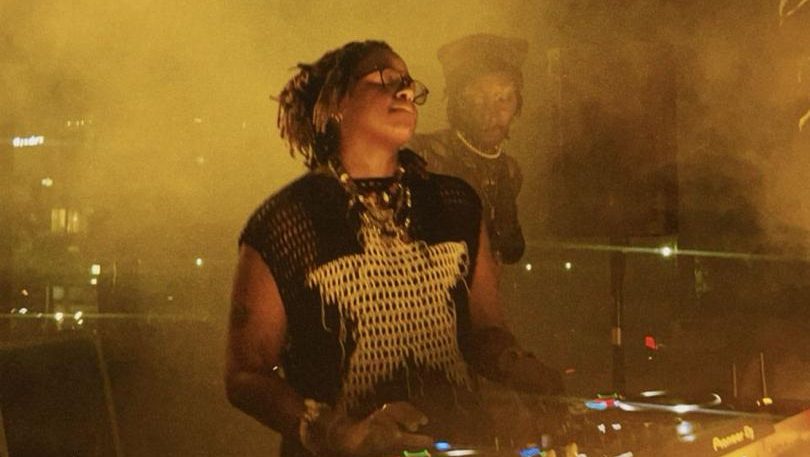
LMNL doesn’t make music for the background. The Lagos-based EDM DJ and producer builds sets that are dark, fluid and deliberately consuming, the kind that pull a room inward and hold it there. Growing up with music in his bones and a mother who performed, LMNL spent years searching for an outlet that matched the depth of what he was hearing inside his head. He found it behind the decks in 2024 and hasn’t looked back since. In a city where afrobeats dominates every conversation, LMNL is doing something quieter and more subversive: carving out a dancefloor that exists between worlds, and inviting anyone willing to surrender to step inside it.
Who is LMNL, and how would you introduce yourself at a house party?
Maestro of the dancefloor, LMNL is an EDM DJ known for curating dark, fluid and groove-driven sets across tech genres that captivate the dancefloor and keep listeners immersed in an experimental sonic journey.
What’s your earliest memory of music, and what pulled you towards it?
Music has always been a very integral part of my life. My mom is a musician, and I grew up very involved in whatever performance outlet I could access. I have always been naturally drawn to music and dancing, and have spent all my life in the pursuit of those passions. I think it was the movement, in the music and inspired by it, that got me. I loved performing, I loved the thrill of the stage and the ability to inspire emotion through song and dance. Music has always been where I felt the most myself.
When did you first get behind a set of decks, and what was that moment like? Was it immediately clear that this was yours?
Femme Africa hosted a DJ workshop that I attended in 2024, and that was the first time I stood behind the decks with any real intention or conviction. It felt natural, immediately. I had been seeking a musical outlet that excited me and encouraged new facets of experimentation, and as soon as I became acquainted with the decks, I knew I had found it.
How long was it between your first time practising and your first time playing for an actual crowd, and what was that first crowd experience like?
It was about a year and a few months between my first time practising and my first time playing for an actual crowd. It was a small crowd, my coworkers at a staff retreat, but the experience had a massive impact on me. It’s one thing to select music and another to read a room and respond to it. Being a DJ requires a mastery in both, and playing in front of that crowd was the first step to understanding the latter. The energy was intoxicating. Since then, I have played in bigger rooms for bigger crowds, and each experience has been its own unique instruction.
“Worlds between worlds” is a striking way to describe what you do. What does that actually feel like from behind the decks? Is there a specific moment in a set where you know you’ve taken a room somewhere else?
From behind the decks, it feels like stepping into a space that exists outside of time, a place that’s both familiar and impossible to describe. It’s heavy and light at the same time, like you’re holding the room in your hands and the room is holding you too. There are moments when the music aligns with the bodies in the space, and suddenly everyone is moving as one, but in their own way. It’s chaotic and perfect all at once. I sometimes describe it as “touching the gates”, existing somewhere between the physical and spiritual realms, dancing with the seen and unseen things around us.
I know I’ve taken a room somewhere else when I can feel the silence between sounds, the pauses between breaths, the way people let go without even realising it. Their focus isn’t on me or anything outside of that moment. It’s just sound, the movement and whatever it is that the music has stirred inside them. That’s when I know we’re in the in-between, in that LMNL space where the set stops being mine and becomes something larger than us all.
You describe your style as “invasive.” That’s a deliberate word choice. What does it mean to you? Are you trying to get under people’s skin, or inside their bodies, or something else entirely?
Yes and yes, that’s exactly what it means. I want my sound to reach into people, touch something deep, awaken a part of them or trigger a release they might not even have realised their body was searching for.
My sets are designed to pull focus, to demand attention and to create a space where people can fully inhabit that moment. It’s about connecting mind and body, letting the music guide movement, and encouraging the crowd to surrender to whatever it is that’s being stirred. It’s invasive in the sense that it doesn’t just sit on the surface. It reaches in, surrounds you and asks for full presence.
Lagos has a reputation for Afrobeats dominance, commercially and culturally. What’s it actually like trying to build a career in electronic music in that environment?
It’s definitely true that there aren’t as many opportunities. Compared to an afrobeats or amapiano DJ, I wouldn’t have as much of a chance to get booked or play my kind of sound. But that limitation comes with its own kind of freedom.
On a cultural level, being in the electronic scene exposes me to really interesting people and conversations that I wouldn’t encounter in a more commercial space. That’s the most exciting part of being an artist: it’s not just about the music, it’s about the community, the ideas, and the experiences that come with it. In a way, working in this space allows me to carve out a different kind of story, one that sits alongside the mainstream rather than inside it.
The rave scene in Lagos has grown significantly over the last few years, with events like Raveoween, Café Riddim, and Mainland House. From your perspective as someone playing these events, what’s changed most about the crowd and what they’re willing to explore sonically?
I think in certain spaces, a lot of newer listeners are still getting introduced to the sound, so they expect to be eased in, often with afrobeat remixes or tracks that feel familiar to their existing tastes. It’s a gentle entry point, and I can understand its importance.
But alongside that, there’s a segment of the crowd that’s desperate and hungry for something different, tired of hearing the same patterns, open to experimentation, and excited by sounds that push boundaries. Both exist side by side, and the balance really depends on the space and the moment. The scene is growing, and with it, the range of what people are willing to explore sonically is expanding too.
Afrotech and Afrohouse are having a genuine global moment right now. Black Coffee, Enoo Napa, and Thembi Muthembwa are pushing it internationally. Do you feel Lagos is being recognised as part of that conversation, or is South Africa still seen as the continent’s sole authority on the sound?
I definitely think Lagos is being recognised as part of that conversation. Artists like Soundsoface, Faem, and Kevin LNDN are already leaving their innovative and unmistakable mark on the scene, and DJs like WeAreAllChemicals, Aniko, and Yosa are creating moments that resonate globally.
What’s interesting is that the Lagos scene itself is undergoing a kind of global reorientation, one that isn’t just about individual artists breaking out, but about how the city’s energy, curation, and spaces are being felt worldwide. It’s a different kind of influence from the South African scene: while South Africa has long been positioned as a continental authority on Afrotech and Afrohouse, Lagos is now carving its own place in the dialogue, with its own sonic identity and approach to the dancefloor. It’s less about following a template and more about expanding the conversation.
There’s a version of this interview where I ask you about the challenges of identifying as he/they in Nigeria and you give me a careful, measured answer. Would you like to go that route, or instead, do you wish people would just stop asking you about it?
I don’t know if this is specific to being he/they as a DJ, but there are real challenges when it comes to being respected or even addressed properly. There’s very little space for transmasc or trans people to exist openly, and most of the time, the conversation around it only happens when someone decides to ask about it in moments like this.
So part of me does wish people would stop asking, not because it isn’t real, but because the industry, and the culture around it, doesn’t actually seem interested in doing the work that would make those questions less necessary. People are mostly avoidant or dismissive about it, curious at best. But curiosity isn’t the same thing as care or change.
At the same time, it’s still part of my reality moving through these spaces. So the tension is that I want the focus to stay on the work and the music, but the conditions around who gets to exist comfortably, or at all, in those rooms are still very uneven.
Do you feel the dancefloor offers a kind of freedom that exists outside of the social rules people carry in with them? And is that something you think about intentionally when building a set?
Yes, the dancefloor is always the first priority when I’m building a set. The curation is very intentional; everything is chosen with movement in mind, and with shaping a very specific LMNL sound for the room.
I do think the dancefloor creates a kind of temporary freedom. When people step into that space, a lot of the social structures they carry outside can soften or dissolve for a moment. The music creates a shared rhythm that people can release into.
So the sets are built with that in mind. The experience is meant to be immersive and a little bit consuming, something that pulls people inward and lets the dancefloor become a place for release, movement, and collective feeling.
Electronic music in Nigeria is still largely a live experience. Streaming numbers and algorithms don’t always reflect what’s actually happening on the ground. Does that frustrate you or do you prefer the music living in rooms rather than on phones?
It doesn’t frustrate me at all. If anything, I think electronic music has always belonged to the room first. As a culture, it was born on dancefloors and in shared physical spaces, so it makes sense to me that its truest form still lives there.
I don’t really see making the charts as the goal. For me, the value of this music is in the experience of it, the way it moves through a room, the way people respond to it together in real time. That’s something streaming numbers or algorithms can’t fully capture.
So I’m actually comfortable with it remaining somewhat outside of that system. It allows the music to exist a little more as art than as product. I’d rather it be something that’s discovered, felt, and lived in rooms than something optimised primarily for phones or platforms.
If you could redesign the ideal Lagos rave venue from scratch, the room, the sound system, the crowd, the vibe, what does it look like?
Ideally, it’s a big, cavernous space on the mainland, somewhere slightly hidden, unmistakably underground. Open, with a lot of room to move and breathe. There’s no stage. The DJ isn’t elevated or spotlighted, they’re somewhere in the crowd, or at least not immediately visible. The focus stays on the collective experience, not the sound selector.
The sound is fully surrounding, something you can feel as much as hear. The music is genre-fluid, groove-driven and deeply curated, moving in a way that takes the room on a long, expansive journey rather than chasing quick moments.
The space is designed with care: free water always available, a quiet sensory room where people can step away and reset, and genderless bathrooms. No cameras, no phones out on the dancefloor, no harsh lights in anyone’s face. Just darkness, sound, and people fully present in the moment.
If you were a food or drink, what would you be?
I’d be a cup of black tea. It’s grounding, warm and a little unexpected. It hits the senses and wakes something inside as it carries a quiet intensity that unfolds more over time. I’d compare it to a familiar yet transformative feeling, very much like the way I want my sound to touch people, awaken their bodies and move them in ways they didn’t know they needed.
If you could play back-to-back with any other DJ in the world, alive or dead, who is it and why?
It would be Bun Xapa. I am such a massive fan of his sound, it would be amazing to experience a sonic conversation with him.
Ten years from now, what do you want the LMNL name to mean, to the Lagos scene specifically, and to the global electronic music conversation more broadly?
Ten years from now, I want the name LMNL to take people straight back to the dancefloor. To a feeling, an atmosphere, a moment suspended between night and morning. Something that only really exists in that in-between. And that’s what I want the name to hold. I want the name to be representative of the space between people and the sound, between the sound and the city, between where Lagos is now and where it’s going. In Lagos, I hope LMNL becomes synonymous with thoughtful curation and dancefloor experiences that feel intentional and transportive. Globally, I want it to signal that something special is happening here, that Lagos isn’t just part of the conversation around electronic music, but shaping new spaces within it.
Leave a Reply