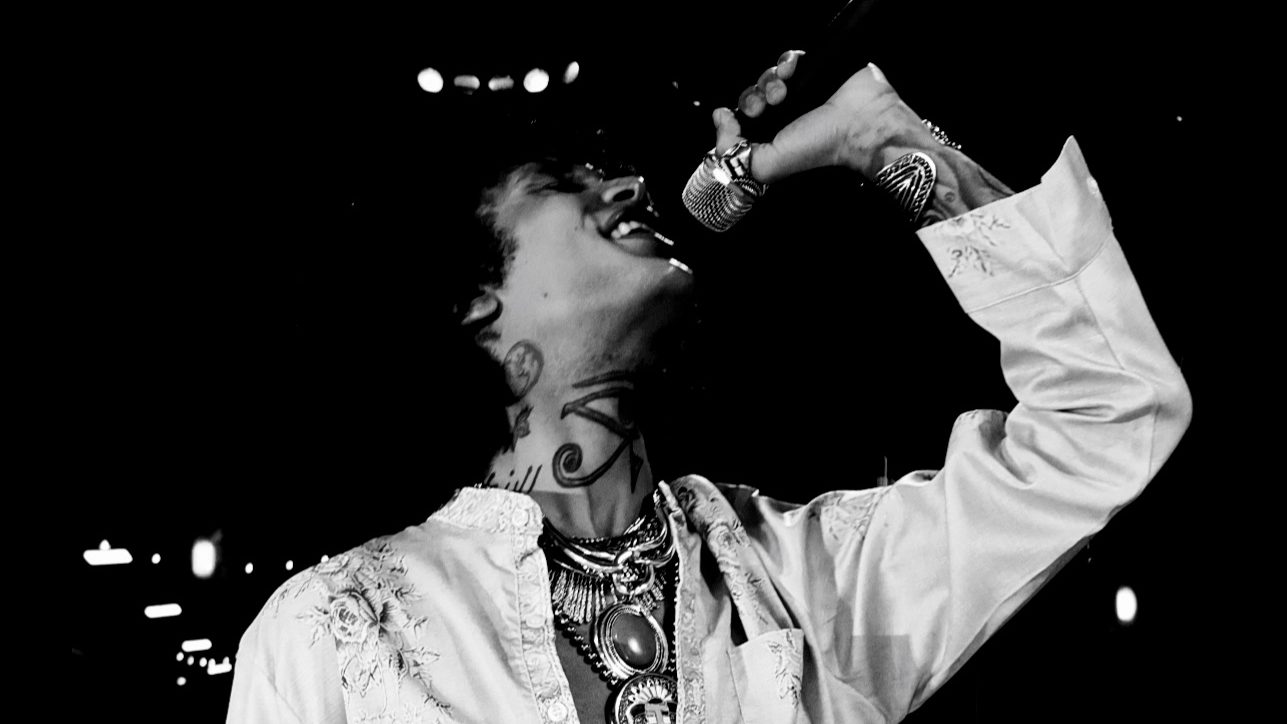
Skyy ZNO has been preparing for this album his entire life, even when he did not know it. Born in the United States, raised in the Dominican Republic, moving back and forth between worlds before most children have decided what they want to be, the Afro-fusion singer, songwriter and composer grew up with the kind of origin story that resists a single sentence. His great-grandmother played piano. His family tree is dense with producers and artists. His cousin is Ab-Liva of The Clipse. Creativity, as he puts it, was never a choice. It was an inheritance.
By seven, he was recording his first song for a school maths project. By fourteen, he had joined a music group and was spending four years learning how to hold a stage. At eighteen, he walked away from the group and toward himself, building a solo sound that would eventually draw comparisons to Bob Marley’s spiritual conviction, The Weeknd’s cinematic pull, and Prince’s creative audacity.
That sound arrives in full on ExitUs, his debut album, released in June 2026 through ZNOVerse Entertainment and SMN Records, the label he co-founded with his father in 2024. Co-produced alongside nine-time Grammy winner Joe Nicolo, whose credits include Lauryn Hill, NAS and Billy Joel, the seven-track project is structured as a continuous arc, moving through acts rather than songs, drawing on Afrobeats, Soul, Salsa, Dembow and Reggae to trace what Skyy calls the “physics of survival.” It is a record rooted in the Maafa, the history of the African diaspora, and what endured through it: the rhythms, the resilience, the ability to make beauty from devastation.
The album has already reached beyond music circles. Her Majesty Queen Diambi Kabatusuila Tshiyoyo Muata of the Democratic Republic of Congo has lent it her public endorsement, calling it a living map of the African musical odyssey. With over 300,000 Spotify streams and 600,000 YouTube views built before ExitUs even dropped, Skyy ZNO arrives not as a newcomer but as someone who has been moving toward this moment for a very long time.
We sat with him to talk about where it all began, what survival actually means, and why the album ends not with resolution but with motion forward.
You recorded your first track at seven for a school maths project. What was in that song, and do you remember how it felt?
It was a song about integers. Looking back at the video now, I can’t help but laugh because I was just a kid, but at the same time I see something much bigger happening. That moment planted a seed. It was the first time I realized music wasn’t just something I enjoyed, it could actually become a path for me. Standing up and performing in front of my entire class gave me a feeling I’d never experienced before. I felt confident, powerful, and proud of myself. It wasn’t about being the best rapper. It was about having the courage to do something most people were too nervous to do. That experience taught me that fear and opportunity usually stand in the same place, and if you’re willing to step through the fear, you might discover what you’re really meant to do.
You spent four years performing in a group from fourteen to eighteen, then walked away to go solo. What made you certain it was time, and what did you leave behind when you did?
From fourteen to eighteen, that group was my whole world. We grew together, learned together, and shared the same dream. But eventually life started asking different questions of each of us. Graduation came, responsibilities became real, and the road we were on split in two. My group member chose college. I chose music. I remember sitting with my dad and telling him not to spend his savings on a degree my heart wasn’t in. I already knew where my purpose lived. Instead of questioning me, he believed in me. He invested in my dream before the world gave him any reason to, and that’s a level of faith I carry with me every time I step into a studio or onto a stage. Walking away wasn’t really about going solo. It was about growing into the person I was becoming. Music stopped being something I wanted to do and became something I felt called to do.
Your family tree runs deep with music, including your cousin Ab-Liva of The Clipse. Growing up, was that legacy something that motivated you or something you felt you had to escape?
Growing up with Ab-Liva in my family gave me something a lot of people never get to experience. It made the impossible feel possible. Success wasn’t just a story I heard about or something I watched on TV. I could see the discipline, the sacrifices, the long hours, and everything that existed behind the accolades. That changed the way I looked at my own dreams. At the same time, it taught me one of the most important lessons I’ve carried into my career: access isn’t the same as achievement. Being close to greatness doesn’t make you great. It might inspire you, it might give you wisdom, but it can’t give you your voice, your work ethic, or your purpose. Those are things every artist has to discover for themselves. I’ve never wanted people to know me because of who I’m related to. I want them to know me because, when they hear my music, they hear honesty. If my name opens someone’s curiosity, that’s fine. But it’s the music that has to keep them listening.
You’re born in the US, raised in the Dominican Republic, gaining traction in the Caribbean, and drawing on sounds from across the African diaspora. How do you decide which version of home a song is coming from?
I never really looked at it as having to choose one version of home because all of those experiences are a part of me. Being born in the United States, growing up in the Dominican Republic, connecting with people across different cultures: it has all shaped the way I see music and the world. To me, music has always been bigger than borders. The sounds that influenced me all come from a deeper history. The foundation traces back to Africa, and through generations of struggle, movement, and resilience, those rhythms evolved into the sounds that have shaped the world: reggae, salsa, soul, Afrobeats, and so many others. When I create music, I’m not trying to decide which culture I’m representing. I’m honoring all the places and people that helped shape who I am. I see myself as a global citizen because I understand that music has always been a bridge. My goal is to create from that place, to make music that reflects where I come from while still speaking to people no matter where they call home.
You describe ExitUs as documenting the “physics of survival.” What does that phrase mean to you, and when did you find it?
When I talk about the physics of survival, I’m talking about the laws that have governed survival long before I was here. The ability of people to endure the unimaginable, to adapt, and to still create beauty from circumstances that were designed to break them. The foundation of ExitUs is connected to the Maafa, the great catastrophe of the African experience through the transatlantic slave trade and its lasting impact on generations of people. But what I wanted to explore was not only the suffering. I wanted to explore what survived. The culture survived. The music survived. The spirituality, the creativity, the traditions, and the ability to find hope in the middle of darkness survived. That’s the physics of survival to me. It’s the force that cannot be measured, but you can see the evidence of it everywhere. You hear it in the rhythms that travelled across oceans. You feel it in the genres that were born from struggle and became some of the most influential sounds in the world. I found that understanding when I started looking deeper into my own identity and realising that my story wasn’t separate from a much larger story.
The album is structured as seven acts in a continuous arc. Why did ExitUs need to be a journey rather than a collection?
ExitUs needed to be a journey because the story itself was never meant to be separated into pieces. The things that shape us don’t happen in isolation. Pain, identity, healing, discovery, and purpose all connect. They build on each other. When I began creating this project, I knew I wasn’t just making songs. I was telling a story about where we come from, what we’ve endured, what we’ve carried, and what we’ve created in spite of it all. The Maafa is not a single moment in history. It’s a continuum of experiences that still influence us today. I wanted the structure of the album to reflect that. The seven acts allowed me to take the listener through different emotions and different stages of that experience. There are moments of darkness, reflection, struggle, and awakening, but there are also moments of power, resilience, and triumph. A lot of albums give you songs you can enjoy individually, and there’s nothing wrong with that. But ExitUs was created with a different intention. I wanted someone to sit with it, to move through it, and to feel like they had traveled somewhere by the time they reached the end. Because that’s how life works. We don’t just remember individual moments. We remember the transformation those moments created.
You co-produced this album alongside nine-time Grammy winner Joe Nicolo. What did that creative dynamic look like in real time?
Joe Nicolo is an incredible person, mentor, and creative force. Working with him was a blessing because he brought decades of experience, but what stood out to me most was his ability to listen. He understood that ExitUs already had a spirit and a message. I wasn’t looking for someone to change the vision. I was looking for someone who could help me bring that vision into focus. His knowledge of production, engineering, musicianship, and storytelling is a big reason why he has achieved the level of success he’s had. But beyond the accolades, what I appreciated was his ability to recognise the emotion behind the music. He helped me sonically crystallise what I was hearing in my head and translate the feeling of the project into something people could experience. Creating alongside someone with nine Grammys could have been intimidating, but Joe created an environment where the focus was always on the music. It wasn’t about ego or titles. It was about making sure the message came through the right way.
ExitUs pulls from Afrobeats, Soul, Salsa, Dembow, and Reggae. Was there a sound you wanted to include that didn’t make the cut?
I’m glad you asked that because those songs are a perfect example of how deep this project goes. I have two songs in Portuguese, one influenced by Bossa Nova and another inspired by Brazilian Funk, that didn’t make the final tracklist. But it wasn’t because they didn’t belong. Brazil carries such a significant part of the African diaspora experience, and the history, the pain, the culture, and the resilience that came through that journey are all connected to this story. For me, ExitUs was about following a specific emotional and sonic path. Every song had to feel like it was carrying the listener through the story I was trying to tell. Those records are part of that world, but I felt they deserved their own moment rather than being placed somewhere they couldn’t fully breathe. That’s one of the hardest parts of creating an album. You have to make decisions based on the story, not just the songs you love. Those songs will have their time.
The album received an endorsement from Her Majesty Queen Diambi of Congo, who called it a living map of the African musical odyssey. What did that mean to you personally?
Honestly, it is one of the greatest honours of my life. There are certain moments in your journey where you realise the work has reached beyond you. Awards and industry recognition are meaningful, but this felt different. Queen Diambi represents a connection to history, culture, and a lineage that existed long before any of us were here. For her to recognise ExitUs as a living map of the African musical odyssey meant a lot to me because this project was created from a place of respect, remembrance, and responsibility. I never wanted to just make music that sounded good. I wanted to honour the stories, the struggles, and the resilience that allowed these sounds to exist in the first place. I don’t carry that recognition as a trophy. I carry it as a responsibility. A responsibility to continue honouring the ancestors, the cultures that shaped us, and the connections that history tried to separate.
The album closes with “Ascend.” What are you moving toward?
My focus is on unification: creating a space where we can come together with genuine purpose and intention. This is the heart of Ascend. The dream that we must unite as a people to rise up again, to heal our collective wounds, and to move forward with a higher frequency. I am committed to elevating as both an artist and an individual, and my sights are set on the absolute top of this industry. I intend to stand alongside the greats who shaped me, so that I can, in turn, help shape the minds of future generations. Everything I do carries that weight of meaning. I am building this movement to be something truly colossal. I don’t take this gift or this opportunity lightly. I feel a deep responsibility to honour it. Failure is simply not an option, and the work of healing and rising together has only just begun.
Leave a Reply