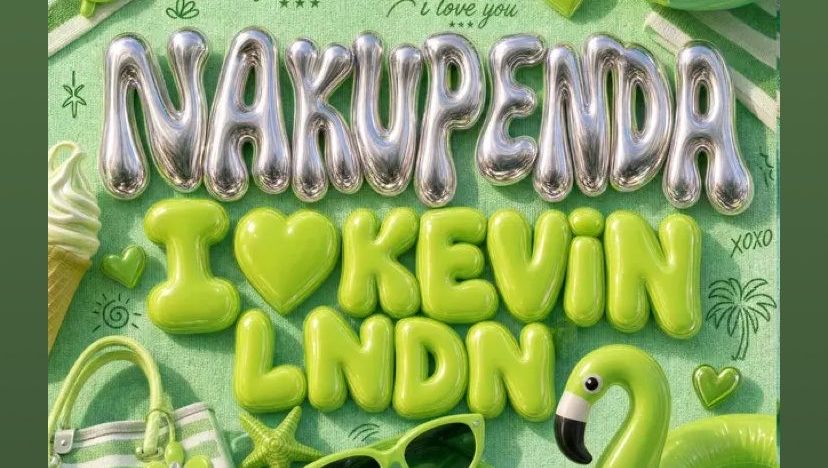
You can talk about Kevin LNDN’s remix of TxC’s “Nakupenda (I Love You),” first and foremost, as a story about the beat. The original, built around Scotts Maphuma and Shoday’s hook and carrying Davido, Zlatan and Al Xapo, moves with an easy, unhurried glide. Kevin LNDN tears that up. His version runs on dark basslines and the heavy log drum pattern that’s become his signature, turning a song into a weightier version of itself.
He describes the process as an extension of what he always does with a record. “I open up Ableton Live, lay down the song, I take out the vocals and then produce my own Gqom beat from scratch over it,” he says, “designed some unique lead sounds, drums, bass lines. I take a lot of inspiration from other genres and my favourite songs, afro tech elements, 3-step elements, creating this interesting take of Gqom.” The production quality alone is reason enough to pay attention to this drop.
You can also talk about paperwork.
The remix arrived as a proper, credited release, one part of TxC’s officially released “Nakupenda: I Love You Summer Pack” project. That detail matters more than it should have to, because it puts Kevin LNDN on the right side of a divide that a lot of remix culture on this continent still doesn’t bother crossing.
Nigerian and South African music has always leaned on remixing as a creative reflex. Take a song that’s already working, hand it to someone else, see what it becomes. That instinct is where the “remixes EP” format itself comes from. DJ Neptune is generally credited with starting the trend in Nigeria, taking his hit “Nobody” and building a full EP of remixes around that single track, with Mr Eazi and Joeboy’s original joined by versions in other languages for other markets. It’s been the template ever since. Chella’s “My Darling” got the same treatment this year, its remix EP handing the song to Diamond Platnumz, Zee Nxumalo and Tawsen and letting each of them take it somewhere the original never went. In both cases, the point wasn’t to protect the song from being touched. It was to hand it out on purpose, to the right people, with the paperwork already sorted.
But that same instinct has a shadow side that doesn’t get talked about as often. A lot of remix activity, especially in Afrobeats, Amapiano and surrounding scenes, still runs on an ask-forgiveness-not-permission logic. It usually looks like this: a producer or DJ flips a stem without a conversation with the owner, a version circulates on Audiomack, becomes a TikTok sound or lands in a DJ mix, and it either catches on or quietly disappears. When it does catch on, the complications tend to show up late. Platforms pull the track. Whoever actually built the version that went viral often has the weakest claim to anything it earns. The original artist’s team gets pulled into a dispute they didn’t start. None of this is unique to African music, but the still-forming rights infrastructure around the continent’s industries specifically makes it a live problem, not an old story.
Here’s the part that complicates the tidy version of this story, and makes it more useful. Kevin LNDN’s Nakupenda remix didn’t begin life as a cleared collaboration. It began the same way most of these do. “As one of the top remixers in the scene, a lot of my friends and DJs asked me to remix the now-trending Nakupenda, and I have to give the people what they want,” he says. “I woke up in the middle of the night and put down the idea for the remix. I entered such a flow state that I was able to finish it in one sitting.”
What happened next is the actual lesson. He didn’t sit on it and hope it would find its way to TxC’s camp on its own. He sent it out, it built momentum through DJ support and viral clips, particularly from UK-based DJ J.Gadget, and the conversations that followed eventually pulled in the people who could make it official. “Honestly, yes, very stressful,” he says of clearing the record. “There was a lot of gatekeeping along the way, some entitlement, even a few attempts to sabotage things. But in the end it’s out for everyone to stream, and I’m genuinely grateful for that. It took the remix going viral, massive DJ support and viral clips, especially from UK-based DJ J.Gadget, who I’d sent it to shortly after finishing it, plus a lot of conversations building online, before LVRN reached out to me through J.Gadget. Around the same time, a music exec at Platoon told me LVRN had actually been looking for me for a while. Once that connected, the clearance process was smoother.”
So the difference between this remix and the ones that vanish isn’t that it started clean. It’s that it didn’t stop at going viral. Kevin LNDN has a back catalogue of versions that never crossed that line, records that built a following in the rave circuit and then hit a wall. “I’ve made so many remixes over the years that never even got close to an official release, the Fun remix with Yosa, the Oblee remix, the Ayra Starr ‘Hot Body’ remix, the Kese Kese remix, honestly, the list goes on,” he says. “You should listen to ‘Rave Fuel Vol 1.’ If you’ve been raving and heard a Nigerian remix out there, there’s a good chance it was mine.”
That’s the pattern he’s up against, and it’s why he sees Nakupenda’s clearance as bigger than one song. “Getting official clearance for remixes has always felt like an uphill battle that goes nowhere. Labels don’t take the requests seriously because it wasn’t part of their rollout plan, or one thing or the other, but then a foreign producer remixes the exact same song and somehow it gets cleared and released, and goes on to blow up,” he says. “So for this to finally happen for me, after so many attempts, it’s a big win for me and my community. It tells me artists and labels are starting to actually pay attention to what’s happening in the electronic scene. It’s a testament to how much everyone in this community has put into growing it.”
That reframes what’s actually worth pointing at here. It isn’t that Kevin LNDN avoided the messy, informal, DJ-driven route that most remixes take. He didn’t. It’s that he treated virality as a starting point for a conversation rather than a finish line, and pushed the clearance through instead of letting the record stay a beloved bootleg. The version of Nakupenda winning right now is the one that made it all the way to credited, which means it’s also the one least likely to get pulled down, disputed, or quietly erased from the conversation six months from now.
That’s a small thing to point at in one remix. But multiplied across enough producers making the same choice, chasing the clearance even when it’s slow and unglamorous, it’s the kind of small thing that actually shifts a culture’s norms. Not a rule handed down from above, but positive reinforcement from watching the version done properly become the version that wins.
Leave a Reply