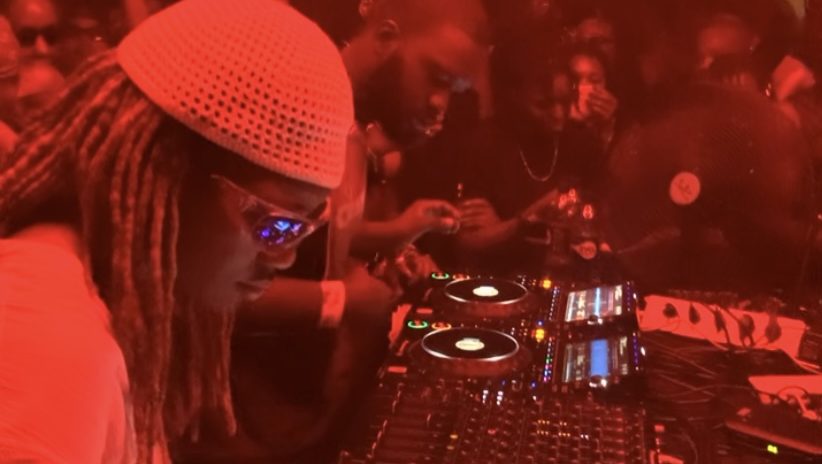
Rave culture was built on specific principles. Amongst many others (secret locations, PLUR), it was built on music-centric experiences that focused on creating a seamless musical journey. It’s a space for the other, the outsider, the outlaws. It is a room for originality and experimentation; hence, all aspects of the experience, most especially the music, must embody these elements.
As the local rave scene grew and started getting more visibility, naturally, most ravers and DJs grew an affinity for particular songs, sounds and genres/sub-genres. Obviously, this was informed by local forces but also by international momentum. Songs and sub-genres that made waves in EDM hotspots like South Africa also found love amongst Nigerian ravers. A good example is the explosion of the AfroHouse sub-genre, 3-step, propelled by the genius of SA artists and DJs like Dlala Thukzin, Thakzin, Ciza, Thukuthela & Jazzworx, and hit singles like ‘Isaka (6 am)’, and’iPlan’. Concurrently, 3-step, its preachers and its biggest sermons gained heavy listenership amongst dance music faithfuls in Nigeria. It’s no coincidence that all the DJs mentioned above have all performed in Nigeria within the last year.
The result of this massive success of a few sounds meant DJs and ravers leaned more into this style compared to others, to an almost predictable degree. Sets became expected\ rather than experimental. A common rhetoric is that one could lose count of the number of times the ‘Dlala Thukzin’ tag comes up at most raves. While this is still a valid rave experience (sometimes, we really just wanna party to the hits tbh), when it becomes the only experience, something essential gets lost.
As DJ LMNL articulated in a recent WeTalkSound interview, “I think in certain spaces, a lot of newer listeners are still getting introduced to the sound, so they expect to be eased in, often with afrobeat remixes or tracks that feel familiar to their existing tastes. It’s a gentle entry point, and I can understand its importance. But alongside that, there’s a segment of the crowd that’s desperate and hungry for something different, tired of hearing the same patterns, open to experimentation, and excited by sounds that push boundaries. “
Some ravers started noticing. The familiarity was setting in, and the weariness was becoming a real thing.
So when I got the email announcing Group Therapy’s new vertical, Side Quests, my attention piqued immediately, over-piqued sef. The mail described the new venture as ‘A night that takes everything you thought you knew about house music, and stretches it. It went on to say, “We are expanding our horizons into the unknown, exploring alternative sounds like Hyperpop, Drum N Bass, Minimal, Tech House, Melodic, Baile Funk, UKG, Ballroom and more. Music and sounds from all over that never seem to get their own room.” What sold me was that the first edition would be curated by Abiodun and his experimental collective, Ile Ijo. The collective has already hosted about four Drum N Bass events in 2025, and I’d recently found love for DnB myself, so I was hoping to hear some of it irl. Anyways, I got my ticket within minutes of getting that mail, hopeful that Side Quests will cure that thirst for more that I and other ravers lowkey had.
The lineup for the event had local DJs, WeAreAllChemicals, Aniko, Abiodun, Momentumm, IMJ, and ISA. It also had Yokothemoon from Ghana and R3ign Drops from Uganda. Speaking on the selection, ABIODUN said, “What informed it was people we were confident were tastemakers and whose range for dance music is diverse enough to produce an impressive set.” The goal was simple: play a blend of all kinds of dance music.
Truly Sidequests: vol. 1 was a night of experimentation and education. It was a display of excellent DJing and prompt appreciation of such displays. The biggest cheers weren’t for ‘hits’, or producer tags. The noise was loudest when the DJs produced impressive moments like Yokothemoon building suspense with a ringtone, or Aniko playing a Jailer remix she had finished minutes before her set. For Abiodun, a major highlight from the night was “When Momentumm started his set playing an oja (igbo flute) on a techno record.”
This is what legendary DJ sets are built on: the ability to take the crowd on a journey, not just play banger after banger. As Damie, another Lagos DJ, shared with WeTalkSound on the responsibility of the DJ: “It’s about educating the crowd.”
But the DJs’ dexterity is only half the story. The crowd’s reaction validated the theory that Lagos ravers have a wide palate and thirst for experiences that challenge the status quo. “The love for the guest DJs and the kind of music they got showed us that the people got what the night was really about,” Abiodun shared.
Side Quests joins a growing list of events in the Lagos scene that prioritise experimentation. Obviously, other events of diverse scale exist within the scene that cater to this need for experimentation and technique. Abiodun and Ile Ijo have consistently explored different pockets of dance music. EDM collective Sweat It Out has maintained the essence of the music over its almost seven years of existence. These spaces understand what Sweat It Out co-founder Ebi shared in a recent chat with WTS:”EDM comes in certain cultures and subcultures. It’s meant to be underground. It’s meant to be expressive. It’s meant to be educational.”
This need for experimentation isn’t just about variety; it’s about the scene’s evolution. As DJ & producer Proton noted when speaking about the local scene’s trajectory: “I see it going places. It’s definitely gonna evolve as time goes on and we’d have more sub-genres and so on.” But that evolution requires intention. DJ KYLA put it plainly: ” [The EDM scene] exploded because people needed new forms of expression and release. But sustainability will depend on intention. If we focus only on hype, it fades.“
Speaking on his ideal rave, LMNL describes it as “a big, cavernous space on the mainland, somewhere slightly hidden, unmistakably underground… The focus stays on the collective experience, not the DJ. The music is genre-fluid, groove-driven and deeply curated, moving in a way that takes the room on a long, expansive journey rather than chasing quick moments.” Side Quests offered something close to that vision. As Group Therapy admits, after years of curating some of the best AfroHouse experiences, it is time to also explore other sounds. It is time to return to what made people fall in love with raves in the first place.
The Dlala Thukzin tag will still ring out at plenty of Lagos raves. And that’s fine. But now there’s one more room for everything else. The sounds that never seem to get their own space, the DJs who prize technique over familiarity, and the ravers who remember that the scene was always supposed to be for the outlaws.
Leave a Reply